Beginner: Patterns 2 & Introduction to Strings
Agenda
- Print reverse triangle V
- Print numeric triangle /\
- Strings
- next() vs nextLine()
- How to deal with different type of inputs
- Character Pattern
Problem Statement
Print the following pattern:
For example,
N = 5
* * * * *
 * * * *
  * * *
   * *
    *
N = 4
* * * *
 * * *
  * *
   *
Warning
Please take some time to think about the solution approach on your own before reading further.....
Observation
Lets consider the spaces as "_"
* _ * _ * _ * _ * _
_ * _ * _ * _ * _
_ _ * _ * _ * _
_ _ _ * _ * _
_ _ _ _ * _
Now lets assume we are removing the spaces after every '*', then
* * * * *
_ * * * *
_ _ * * *
_ _ _ * *
_ _ _ _ *

While printing stars, remember to print a space after every star, to get the our required reverse triangle pattern.
Code
for (int i = 0; i < N; i++) {

   //loop to print i spaces
    for (int j = 1; j <= i; j++) {
        System.out.print(" ");
    }

    //loop to print n-i stars
    for (int j = 1; j <= n - i; j++) {
        System.out.print("* ");
    }

    System.out.println();
}
Problem Statement
Print the following pattern:
For example,
N = 5
0 0 0 0 1 0 0 0 0
0 0 0 2 3 2 0 0 0
0 0 3 4 5 4 3 0 0
0 4 5 6 7 6 5 4 0
5 6 7 8 9 8 7 6 5
0 0 0 1 0 0 0
0 0 2 3 2 0 0
0 3 4 5 4 3 0
4 5 6 7 6 5 4
Warning
Please take some time to think about the solution approach on your own before reading further.....
Approach
Lets divide the pattern into two halfs,
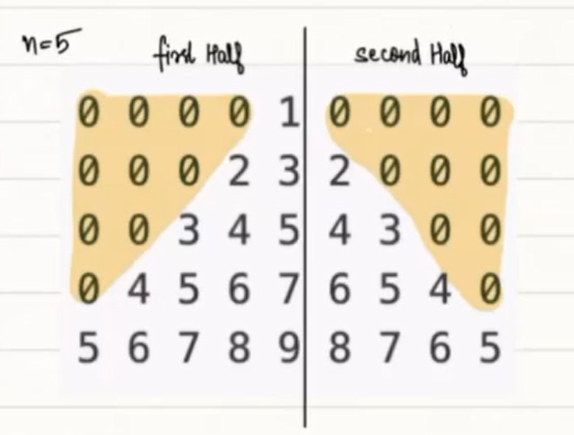
Lets consider the 2 halves separately,
First Half
| 0 | 0 | 0 | 0 | 1 |
|---|---|---|---|---|
| 0 | 0 | 0 | 2 | 3 |
| 0 | 0 | 3 | 4 | 5 |
| 0 | 4 | 5 | 6 | 7 |
| 5 | 6 | 7 | 8 | 9 |
Lets create a table, on observing the pattern.
| row | zeros | start | end |
|---|---|---|---|
| 1 | 4 [5-1] | 1 | 1 [2*1-1] |
| 2 | 3 [5-2] | 2 | 3 [2*2-1] |
| 3 | 2 [5-3] | 3 | 5 [2*3-1] |
| 4 | 1 [5-4] | 4 | 7 [2*4-1] |
| 5 | 0 [5-5] | 5 | 9 [2*5-1] |
We can come up with an generalized pattern on observing the values of the table based on the value i.
| ith row | (n - i) zeros | starts with i | ends with 2 * i - 1 |
|---|---|---|---|
Psuedo code for First Half
// Printing (n - i) zeros
for (int j = 1; j <= n - i; j++){
    System.out.print(0 + " ");
}

int lim = 2 *i - 1;
// Printing the increasing numbers from i to 2*i-1
for (int j = i; j <= lim; j++){
    System.out.print(j + " ");
}
Second Half
| 0 | 0 | 0 | 0 |
|---|---|---|---|
| 2 | 0 | 0 | 0 |
| 4 | 3 | 0 | 0 |
| 6 | 5 | 4 | 0 |
| 8 | 7 | 6 | 5 |
Lets create a table, on observing the pattern.
| row | start | end | zeros |
|---|---|---|---|
| 1 | 4 | ||
| 2 | 2 [2*2-2] | 2 | 3 |
| 3 | 4 [2*3-2] | 3 | 2 |
| 4 | 6 [2*4-2] | 4 | 1 |
| 5 | 8 [2*5-2] | 5 | 0 |
We can come up with an generalized pattern on observing the values of the table based on the value i.
| ith row | starts with (i * 2 - 2) | ends with i | (n i) zeros |
|---|---|---|---|
Here starts with (i * 2 - 2) can be even simplified, by using the end value of the previous calculation as end - 1.
Psuedo code for Second Half
// For the Second Half
// Printing the decreasing numbers
int lim = 2 *i - 1;
for (int j = lim - 1; j >= i; j--){
    System.out.print(j + " ");
}

//loop to print n - i zeros
for (int j = 1; j <= n - i; j++){
    System.out.print(0 + " ");
}
Overall Code
for (int i = 1; i <= n; i++){

    // For the First Half
    //loop to print n - i zeros
    for (int j = 1; j <= n - i; j++){
        System.out.print(0 + " ");
    }

    int lim = 2 *i - 1;
    // Printing the increasing numbers from i to 2*i-1
    for (int j = i; j <= lim; j++){
        System.out.print(j + " ");
    }

    // For the Second Half
    // Printing the decreasing numbers
    for (int j = lim - 1; j >= i; j--){
        System.out.print(j + " ");
    }

    //loop to print n - i zeros
    for (int j = 1; j <= n - i; j++){
        System.out.print(0 + " ");
    }

    System.out.println();
}
Reading Inputs for Strings
1. sc.next()-> cannot take spaces as input
Ques1:
Input: "Hello World"
String s1 = sc.next();
System.out.println(s1);

String s2 = sc.next();
System.out.println(s2);
Hello
World
Explanation:
s1 will have first word, Hello
s2 will have next word, World
2. sc.nextLine() -> can take spaces as well, until next line is encountered.
Ques1:
Input: Hello World
String s3 = sc.nextLine();
System.out.println(s3);
Output:
Hello World
Question
Input :
Hello World
Scanner scn = new Scanner(System.in);
String str1 = scn.next();
String str2 = scn.next();
System.out.println(str1);
System.out.println(str2);
Choices
- Hello
World - Hello
- World
- None of the above
Output:
Hello
World
Explanation:
str1 will have, Hello
str2 will have next word, World
Question
Input:
Hello Welcome in Robin Dhole blog
Scanner scn = new Scanner(System.in);
String str1 = scn.next();
String str2 = scn.nextLine();
System.out.println(str1);
System.out.println(str2);
Choices
- Hello
- Error
- Hello
Welcome in Robin Dhole blog - None of the above
Output:
Hello
Welcome in Scaler
Explanation:
str1 will have first word, Hello
str2 will have complete line after hello, Welcome in Robin Dhole blog(including space before welcome).
Rule: When the inputs are given in separate lines, and we take a String input using nextLine() after taking number input[nextInt(), nextLong(), nextFloat(), nextDouble()] or a single word [next()] then we get a empty String.
Example
Input
45
Hello World!
Scanner sc = new Scanner(System.in);
int x = sc.nextInt(); // x[45]
String st = sc.nextLine(); // st -> Empty String
String st2 = sc.nextLine(); // st2 -> "Hello World!"
System.out.println(st);
System.out.println(s2);
Output
Hello World!

Hello World!
Question
Predict the output :
Input-
11
Super Excited!
Scanner scn = new Scanner(System.in);
int x = scn.nextInt();
String str = scn.nextLine();
System.out.println(x);
System.out.println(str);
Choices
- 11 Super Excited!
- Error
- 11
Super Excited! - 11
Question
Predict the output :
Input-
11
Super Excited!
Scanner scn = new Scanner(System.in);
int x = scn.nextInt();
String str = scn.nextLine();
System.out.println(x);
System.out.println(str);
System.out.println("The End");
Choices
- 11 Super Excited! The End
- 11
The End - Error
- 11
Super Excited!
The End
Character:
A character represent a single symbol.
There are different types of characters:
- Uppercase characters : ['A' - 'Z']
- Lowercase characters : ['a' - 'z']
- Numeric characters: ['0' - '9']
- Special characters: ['@', '#', '$', '%', '&'...]
There are a total of 128 characters.
Syntax
Example 1:
char ch = 'a';
System.out.println(ch);
a
Example 2:
char ch = 'ab';
System.out.println(ch);
Error: Only a single symbol is a character.
Problem Statement
Write a program to print all characters from A to Z.
Code
public static void printCharacters(String str) {
    for(char i = 'A'; i <= 'Z'; i++) {
        System.out.println(i);
    }
}

public static void printCharacters(String str) {
for(char i = 'A'; i <= 'Z'; i++) {
System.out.println(i);
}
}
Character Stairacase Pattern
N = 5
A
A B
A B C
A B C D
A B C D E
N = 3
A
A B
A B C
Warning
Please take some time to think about the solution approach on your own before reading further.....
Approach
Consider the spaces as underscores (for better visualization).
Lets take N = 5,
A _
A _ B _
A _ B _ C _
A _ B _ C _ D _
A _ B _ C _ D _ E _
Lets assume we are printing the standard stair case pattern,
1
1 2
1 2 3
1 2 3 4
1 2 3 4 5
Now both the patterns is similar. So, instead of printing numbers, we just create a new variable, which starts with A, then increment inside the innerloop.
Code
for (int i = 1; i <= N; ++i) {
    char ch = 'A';
    for (char j = 1; j <= i; j++) {
        System.out.print(ch + " ");
        ch++;
    }
    System.out.println();
}

for (int i = 1; i <= N; ++i) {
char ch = 'A';
for (char j = 1; j <= i; j++) {
System.out.print(ch + " ");
ch++;
}
System.out.println();
}