Design Tic-Tac-Toe
What is Tic-Tac-Toe?
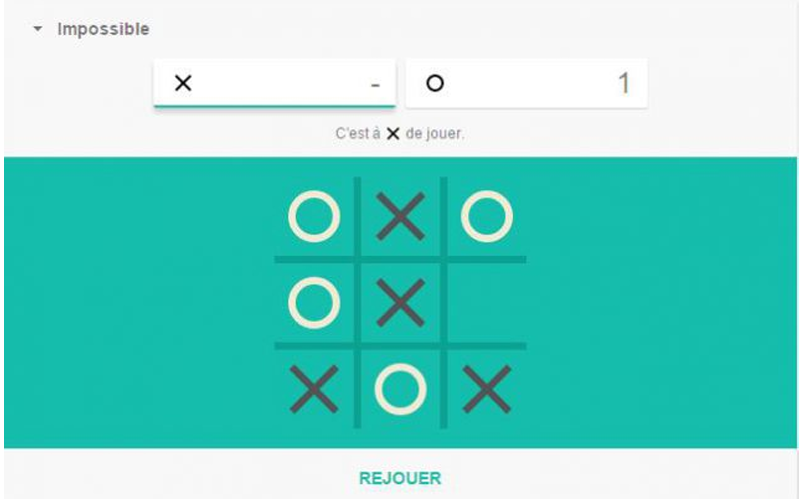
TicTacToe is a 2 player game played on a 3 x 3 board. Each player is allotted a symbol (one X and one O). Initially, the board is empty. Alternatively, each player takes a turn and puts their symbol at any empty slot. The first player to get their symbol over a complete row OR a complete column OR a diagonal wins.
You can play the game within Google Search by just searching for “tictactoe”!
Questions to Ask
- Will the game be played amongst only 2 players or can there be any number of players in future?
- Is the board size restricted to 3x3 or can it be any NxN?
- Can there be different ways to win? Can one of the players be a bot?
- Feature Suggestions:
- Do we want to time a move? Skip/ Declare the other person as winner if the move doesnʼt happen within x seconds.
- Do we want to support undo operation?
- Can there be some players who are just watching? Not playing.
- Do we want to store analytics? Basically previous games, who played what move etc.
- Support for tournaments? Basically a set of matches, each match between 2 players of the tournament.
Expectations
- The code should be working and functionally correct
- Good software design practices should be followed:
- Code should be modular, readable, extensible
- Separation of concern should be addressed
- Project structured well across multiple files/ packages
- Write unit tests
- No need of GUI
Problem Requirements
- Board can be of any NxN size.
- There can be two players.
- Each player will be allotted a symbol.
- The symbol can be one of O and X.
- The players can be either humans or bots.
- Each human player will have a name, email and profile image.
- Each bot player will have a difficulty level.
- Any random player can start the game.
- Then the players will take turns alternatively.
- The player with any consecutive N symbols in a row, column or diagonal wins.
- If the board is full and no player has won, the game is a draw.
Entities and their attributes
- Game
- Board
- Players
- Board
- Cells
- Cell
- Row
- Column
- Symbol
- Human Player
- Name
- Profile Image
- Bot Player
- Difficulty Leve
Design
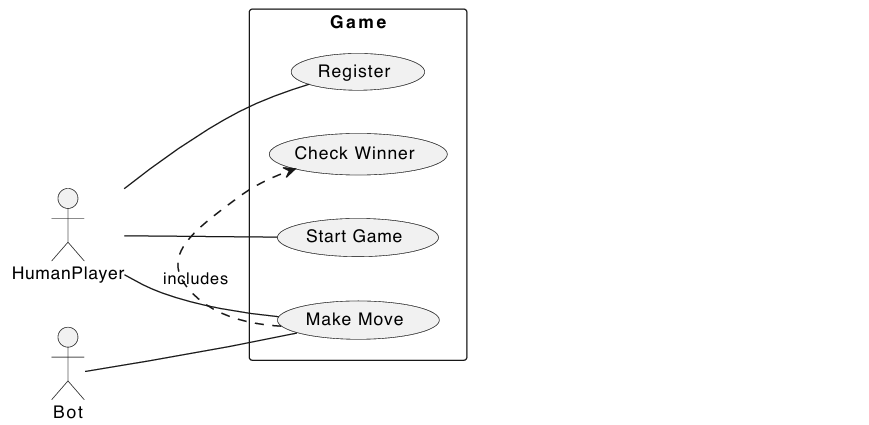
Use Case Diagram
Initial Design
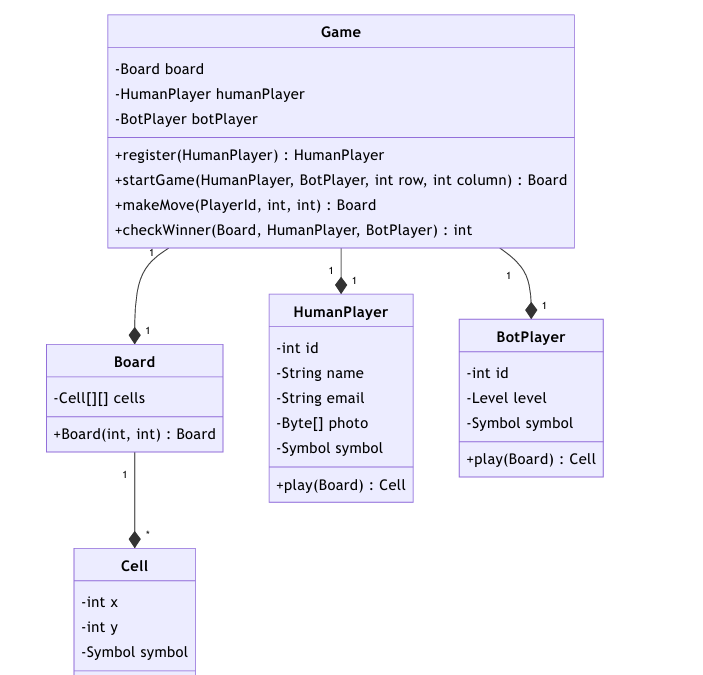
There is no common contract for players. Parent class to represent all different types of players.
- There is tight coupling between Game and different types of players. It is not extensible to support multiple players
- OCP and SRP violation in play method.
- Huge memory consumption - multiple instances of the player will be created for multiple games. Each instance has a new photo.
Common contract - Player abstract class
- Common behaviour - play
- Common attributes - Symbol
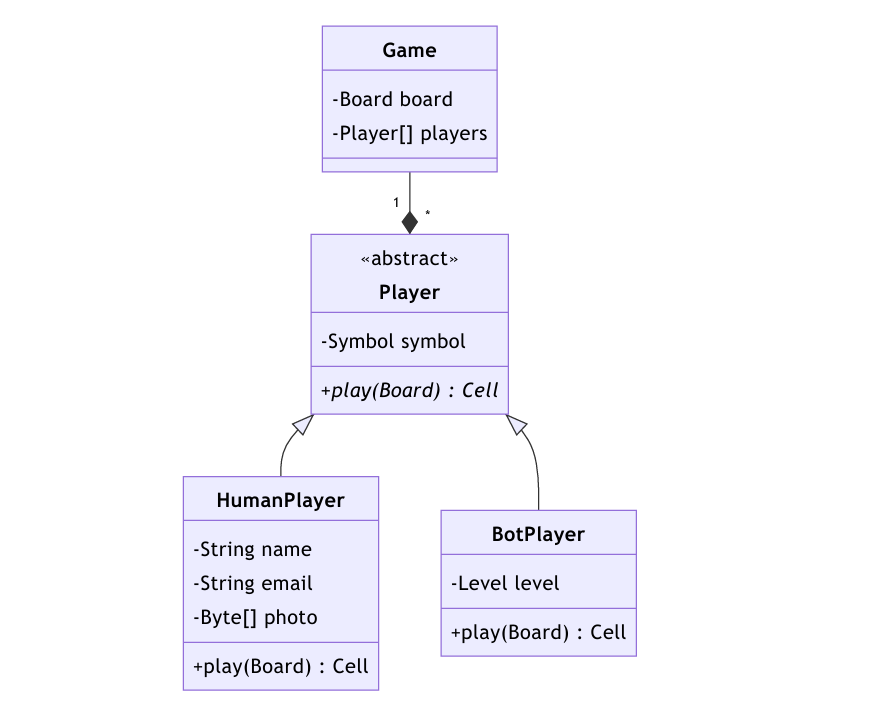
- There is no common contract for players. Parent class to represent all different types of players.
- There is tight coupling between Game and different types of players. It is not extensible to support multiple players
- OCP and SRP violation in play method.
- Huge memory consumption - multiple instances of the player will be created for multiple games. Each instance has a new photo.
Tight coupling
-HumanPlayer
-BotPlayer
-Player[] players
OCP and SRP violation in play method - Strategy
Huge memory consumption - Flyweight
- Paul Morphy
- Instance 1
- name - Paul Morphy
- email - paul@blind.in photo -
- 5MB symbol - O
- Instance 2
- name - Paul Morphy
- email - (mailto:paul@blind.in) paul@blind.in
- photo - 5MB symbol - X (mailto:paul@blind.in)
- Store fields that do not change in a class - Intrinsic state
- Store field that change in a class - Extrinsic state

- Problems so far
- OCP and SRP violation in play method.
Implement different levels in a bot
 class BotPlayer {
  private Level level;
  private Cell play(Board board) {
    switch (level) {
      case EASY:
        // Really easy move
      case MEDIUM:
        // Medium level moves
    }
  }
 }

- Inject different behaviours
- Such that they can be reused
- Strategy Design pattern
- There is no common contract for players. Parent class to represent all different types of players. - Abstract classes
- There is tight coupling between Game and different types of players. It is not extensible to support multiple players - List<Player>
- OCP and SRP violation in play method.
- Strategy pattern
- Huge memory consumption - multiple instances of the player will be created for multiple games. Each instance has a new photo. - Flyweight