Refresher: Functions
Recap
- DRY RUN - Running code line by line, we run the code just like the compiler does without using human intelligence.
- Loops - instead of writing the code multiple times, we use loops to perform the same task
- Nested Loops - These are loops inside loops.
- We usually use
ifor rows andjfor columns.
QUIZ 1
What will the sequence be generated by the following?
range(-5,0,1)
Choices
- -5,-4,-3,-2,-1,0
- Nothing
- 0,-1,-2,-3,-4,-5
- -5,-4,-3,-2,-1
QUIZ 2
What will the sequence be generated by the following?
range(-10,-5,-1)
Choices
- -10,-9,-8,-7,-6,-5
- -10,-9,-8,-7,-6
- Nothing
- -6,-7,-8,-9,-10
QUIZ 3
What will be the output of the following?
for i in range(1,10):
    if(i % 3 == 0):
        break
    print(i, end = ' ')
Choices
- 1 2 3 4 5 6 7 8 9
- 1 2
- 1 2 4 5 7 8 9
- 1 2 4 5 6 7 8
QUIZ 4
What will be the output of the following?
for i in range(0,4):
    for j in range(0,i):
        print('a', end = '')
    print()
Choices
- a
aa
aaa - aaaa
aaaa
aaaa
aaaa - aaa
aa
a
Need for functions
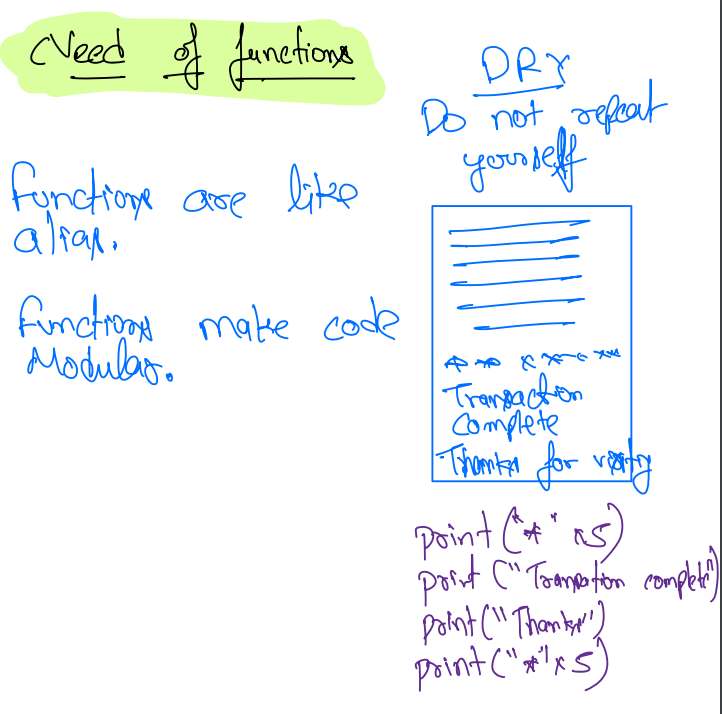
- We are working at a banking facility. We are to code the receipt that is printed after the ATM transaction. It is something like:
******************
Transaction Complete
Thank you for visiting
******************
print('*' * 5)
print("Transaction complete")
print("Thank you for visiting")
print('*' * 5)
- Now for every type of transaction same message will be printed. And for every transaction contained in the big file of 10000 lines of code, we have the same 4 lines for different transactions.
- This is not following the DRY(Do not repeat yourself) principle. Which is a bad practice.
- Let us say the back says they don't want to print
thank youthey wish to printthanksinstead. So we will have to update it at all the places separately. - Functions are like alias - I can write a line of code and I can name it
abc. Everywhere I can call abc the same piece of code will be executed. - Functions make code modular.
- Now if there are any changes, we change it in one place and it will reflect in all the other places.
Syntax of Defining a Function
Defining a function
def function_name():
    # actions
To Call the function
function_name()
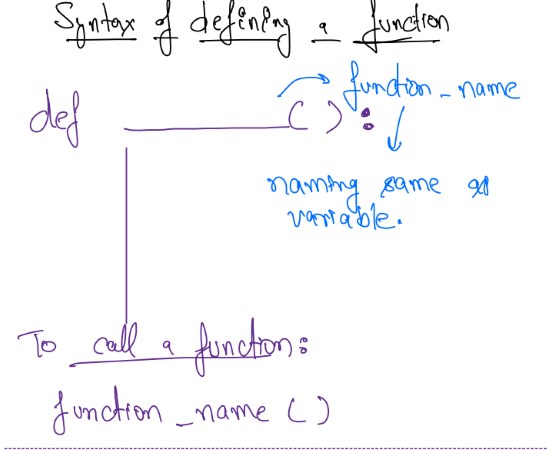
- The naming convention for a function is the same as variables.
- It should be composed of alphabet, number, and underscore
- should start with an alphabet or underscore
- It should not be a keyword
- In Python we use snake case. (there are two cases camel case and snake case).
Return Statement
- Functions not only put some code in a block they return something.
- Example function
def area_circle_rad_5(){
    print(3.14 * 5 * 5)
}
area_circle_rad_5()
Output
78.5
- This is how we define a function and call it. Now we want to add
1to it or2to it. Can't we take it to a variable? - This is what return statements are for. It is like a black box where you want some task to be done. But after the task is done you want it to return some value as well.
- So the syntax is something like:`
def function_name():
    return 5;

abc()
a = abc()
print(a)
5
- We are storing the return value of the function in a variable
a. Now we can print this variable as usual. - Unlike other programming languages in Python we are not required to define the return type with the function name.
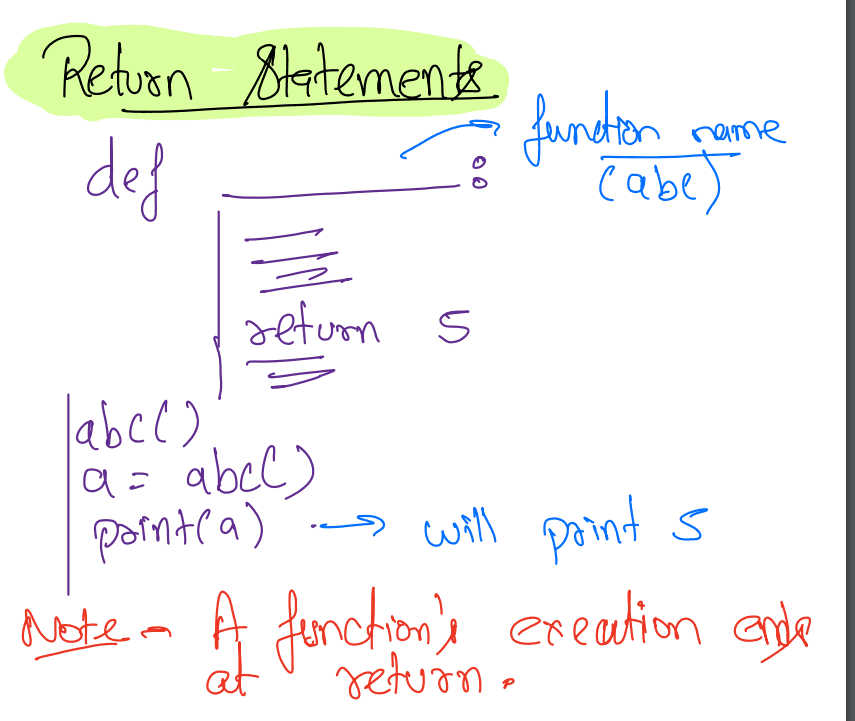
Note: Functions execution ends at return. Once a return statement is found rest of the lines of the code will not be executed. It is just like a break in loops.
If you do return without any value, it will return None.
def abc():
    return
abc()
Parameter and Argument in Function
- Let us say we want to calculate the area of a circle whose radius
10. We will again write the code asdef area_circle_rad_10(): print(3.14 * 10 * 10) - So for every different radius we will write a different code? This is not a good practice.
-
In Python we can take as many parameters as required. So we can simply take radius as a parameter from the use.
def area_circle(radius): return (3.14 * (radius ** 2)) area = area_circle(5) -
If you want multiple parameters you can simply separate them by comma, their types are not required.
- If the function is not returning anything by default it will return
None. - In Python, a parameter is a variable used in a function definition, while an argument is an actual value passed to the function during a call.
- About the above function
radiusused in thearea_circle()function is a parameter, the5passed to it while calling is an argument. - But people use it interchangeably.
Execution of A Function in Python
- Python compiler executes line-by-line
- Everything in Python is an object of a class.
- Function is also a class.
- Function is just like a variable, a variable gets declared in a single line, and functions get declared in multiple lines.
- In Python if you call a function without defining it, it will show an error.
- We can call a function inside a function.
- Let us say we have a bank function to do transactions for saving accounts. We have multiple functions to check the balance, to execute the transaction, to print the thank you message, etc.
Scope of a Variable
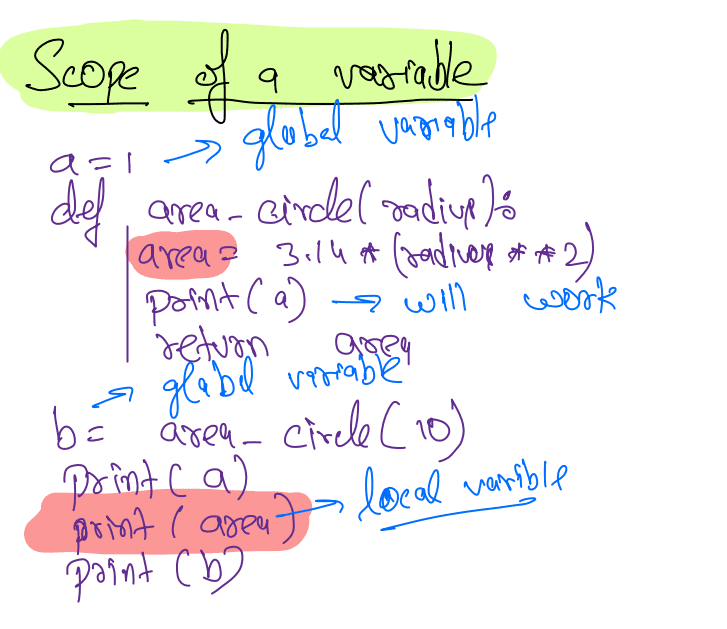
a = 1
def arae_circle(radius):
    area = 3.14 * (radius ** 2)
    return area
b = area_circle(10)
print(a)
print(area)
print(b)
- Whatever we have done so far, we have done it in global scope.
- Here
aandbare global variables. Butareais a local variable to the functionarea_circle. It can only be accessed in the function. As the execution of the function is over the Python compiler frees up the memory. Thusareais no longer a valid memory location. - Though we can do this:
a = 1
def arae_circle(radius):
    area = 3.14 * (radius ** 2)
    print(a)
    return area
b = area_circle(10)
print(a)
print(area) # this will give error
print(b)
- This is because
ais a global variable and can be accessed everywhere.
- In Python variables defined in
iforforloops can be used outside their block as well but it is not true for the functions.
a = 1
def abd():
    a = 2
    print(a)
abc()
Output
2
1
- So, this will have two variables called
a. One is global and another is local. When we sayprint(a)it will refer to the local variable and print its value. - To update or use global we use the following syntax:
a = 1
def abc():
    global a
    a = 2
    print(a)
abc()
print(a)
2
2
a is reused and its value is changed inside a function.
QUIZ 5
Is this a valid function?
def print_hello:
    print('Hello')
Choices
- Yes
- No
There are no paranthesis in the function and they are must in a function.
def print_hello():
    print('Hello')

def print_hello():
print('Hello')
QUIZ 6
Is this a valid function?
def print_name():
    print('Hello', name)
Choices
- Yes
- No
The variable name must be taken as an argument.
QUIZ 7
How many times the function foo is called?
foo()
foo()
for i in range(1,5):
    foo()
Choices
- 5
- 6
- 7
- 8
QUIZ 8
What will be the output of the following?
def area_rectangle(l, b):
    area = l * b
area_circle(3, 4)
print(area)
Choices
- 12
- 7
- Error
There is no function named area_cirle().
QUIZ 9
What will be the output of the following?
def foo(a):
    if(a):
        return 100
    a += 20
    return a
print(foo(0))
Choices
- 100
- 120
- 20
- Nothing
A function's execution ends once a return is encountered.
If you do return without any value, it will return None. Though this is not helpful it is still valid.
def abc():
    return
abc()
QUIZ 10
What will be the output of the following?
def solve(a, b):
    print('Function Started')
    return 0
    c = a + b
    print('Function Ends')
c = solve(2, 3)
print(c)
Choices
- Function Started
Function Ends
5 - Function Started
Function Ends
0 - Function Started
0
Function Ends - Function Started
0
We are doing early exit via return 0 and therefore the result is 0.
Positional and Keyword Arguments
Let us consider an example:
def bio_data(name, age, gender):
    print("Name: ", name)
    print("Age: ", age)
    print("Gender: ", gender)

bio_data(23, "Male", "Aakar")
What is the problem with the above code?
- The order of the parameter matters, age will printed with the name, and so on
- Python has two types of arguments Positonal and Keyword.
- The above function call is referred to as positional arguments. Where order or position of arguments matters.
- The other one is keyword argument. Here we have to give the name of the argument but the order doesn't matter.
- The name must be the same as given in the function definition.
bio_data(name = "Aakar", gender = "Male", age = 23)
Note: A single call can have both together, but the Keyword argument must always be after positional arguments. Python will show an error if not done this way.
Cannot Do
bio_data("Aakar", age = 23, "Male")
Must Do
bio_data("Aakar", age = 23,gender = "Male")
Default and Non-default Arguments
- Let us say we are writing the above function. For example, people don't like having to declare their gender. So, we can give the default argument gender with the value
Unspecifiedin Python.
def bio_data(name, age, gender = "Unspecified"):
    print("Name: ", name)
    print("Age: ", age)
    print("Gender: ", gender)

bio_data(23, "Aakar")
Now, it is both ways okay even if we define or do not define the argument.
Note: A single call can have both together, but the Non-default argument must always be after default arguments. Python will show an error if not done this way.
Cannot Do
bio_data(name, age = 23, gender)
Must Do
def bio_data(name, age, gender = "Unspecified"):
QUIZ 11
What is the correct way of calling this function?
def print_biodata(name, age, gender):
    print('Name', name)
    print('Age', age)
    print('Gender', gender)
Choices
- print_biodata('Hari', 'Male', 23)
- print_biodata('Male', 'Hari', 23)
- print_biodata('Hari', 23, 'Male')
- print_biodata(23, 'Hari', 'Male')
QUIZ 12
What will be the output of the following?
def print_biodata(name, age = 23, gender = 'Female'):
    print('Name', name)
    print('Age', age)
    print('Gender', gender)
Choices
- Yes
- No
First there should be non-default arguments and then the default arguments.
QUIZ 13
Which of the function call is correct?
def print_biodata(name, age = 23, gender = 'Female'):
    print('Name', name)
    print('Age', age)
    print('Gender', gender)
Choices
-
print_biodata(name='Hari', 23) -
print_biodata('Hari', 23, age=23) -
print_biodata('Hari') -
print_biodata() -
1st option -
nameis a keyword argument and the age is a positional argument. Positional argument cannot come after keyword argument. - 2nd option - In the above quiz we are defining age twice which is not valid.
- 3rd argument - Rest two arguments are default
-
4th option - We still need name argument as name is not a default argument.
-
*args- opens a list/tuple (arguments) - **
kwags- opens a dictionary (keyword arguments) *is used for opening a single-dimension iterator.- Let us say there exists a function that takes an unspecified number of parameters.
- This can be achieved with the help of
*argsand**kwargs. This lets us pass as many arguments as we want.
def abc(a, b, *args, **kwargs):
    print(a, b)
    print(args)
    print(kwargs)

abc(2,3,4,5, name = "Hari",age = 23)
2 3
[4, 5]
{"name" : "Hari"
"age" : 23}
- You cannot have more than one
*argsor**kwargsas their behavior of it is unspecified.
Docstrings
- Python provides a special functionality doc strings just like comments but slightly different than multiline comments.
- If someone wants to know how the function works they have to come to the code and see. So many Python code readers and default Python provides a documentation of functions and classes and these are called Doc String
- You have to write a multiline comment right after the function definition.
def bio_data(name, age, gender = "Unspecified"):
    """
    This function prints the bio-data using the information provided

    Args:
        name
        age
        gender

    Returns:
        None
    """
    print("Name: ", name)
    print("Age: ", age)
    print("Gender: ", gender)
To read the doc string, just add a ? after it.
bio_data?
Question - Simple Interest
- Take two parameters, how much they want to invest, and how long they want to invest it for.
- Simple interest - 7%.
- Write a function
print_interest
si = 7
principal = int(input("How much you want to invest>"))
time = float(input("How long you want to invest it for (in years)?"))

def print_interest(principle, time):
    result = principle * time * si / 100
    return result

result = print_interest(principle, time)
print(result)
Question - Simple Interest
- Round function in Python rounds the number. It takes the number and the precision we want. It rounds off this number and returns it.
round(3.1415,2) -> 3.14 - Given a radius
R, print the area of a circle but up to two decimal places only.
PI = 3.14159
def print_area(radius):
    area = PI * (radius ** 2)

result = print_area(5)
print(result)